Platonic polyhedra sounds so much more sophisticated than 3D shapes, doesn’t it? Actually, in our math history lessons, we found that the 5 now called “Platonic” solids were actually identified by the Pythagoreans (Pythagoras and his students) before Plato’s name became attached to them. Of course, we were not content to see them in a book, we had to construct them. That is only logical to me; otherwise how can you truly understand these figures?
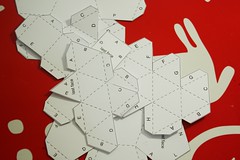
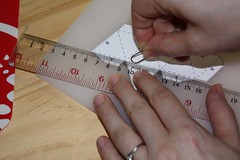
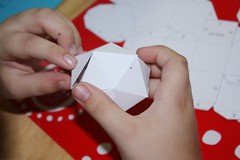
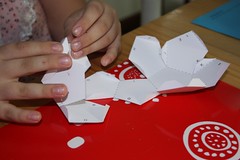
We used this wonderful resource for printable templates: Platonic Solids Mobile. I printed the nets (as flattened 3D shapes are called) onto cardstock, then cut and scored them. Scoring makes a huge difference for a mathematical craft like this; it enables you to fold precisely. Just place a ruler along the line to score, and press with the rounded edge of a paperclip. It took patience and white glue to get them to hold together.
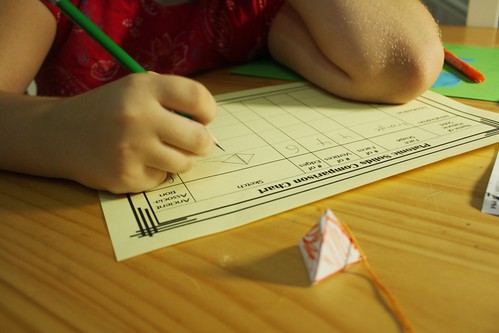
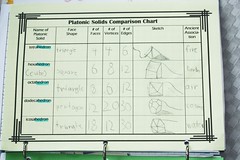 Before stringing the mobile, Sprite had to fill out this comparison chart (I created) for analyzing the features of the five figures. She found it helpful to mark the faces, vertices (tips), and edges to keep track.

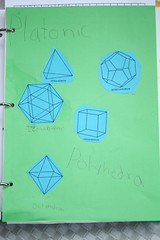 Sprite used the diagrams from page 2 of this book excerpt to create a notebooking page which we referred to quite a lot since the names of these figures don’t come too easily. But they are mighty fun to say!
- icosahedron
- tetrahedron
- hexahedron (also known as a cube)
- dodecahedron
- octahedron
Putting the mobile together was another mathematical experience. Sprite had to discover which way to shift the strings to balance the mobile.
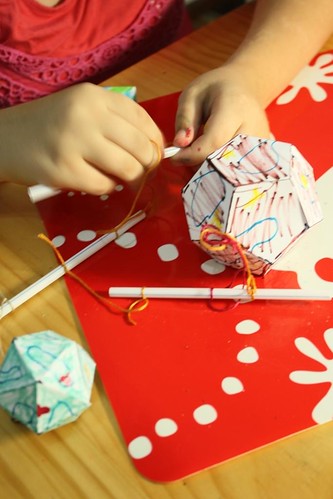
When we found the perfect arrangement, we taped the strings to the straws.
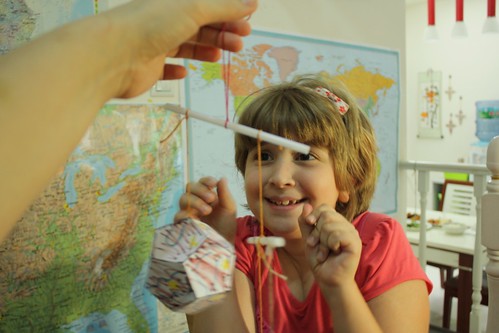
And here it is, ready for the cats to attack. (That is what happened, you know.)
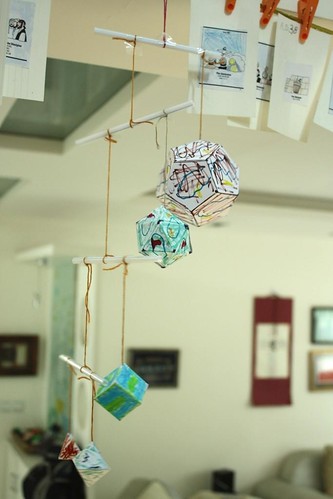
This whole project was a tangent that I took off on. Our scheduled reading, the chapter on Pythagoras in Mathematicians are People, Too, is what inspired me. So this was actually a four day activity that was a footnote to our (supposed to be) two week long Pythagoras study. Yeesh!
Living math is so messy! Not just in glue and squares of paper, either. I like things to be linear, but I’m finding that living math is not a neat path from A to B to C and so on. Instead it jumps ahead to QRS and then circles back to pick up DE and F. So I’m adjusting to this new style and trying to enjoy where it takes us.
We do have an outline, but when we find a mathematical concept we want to veer off track towards, we go ahead. It’s all math, and it doesn’t bother me anymore that the tangents we choose are not in the textbook or not “grade appropriate.”
Later when we study Euler, another mathematician, we’ll revisit these shapes with this chart — Euler’s Formula with Platonic Solids.
Your tangents are much more educational than my tangents!
.-= Marsha´s last blog ..My (not always funny) father =-.
Hey but messy is fun and fun is learning. Way to go!
.-= Martha´s last blog ..My School Room =-.
OK Sprite will be the leader of the free world and she’ll teach us how to have fun while learning to get along. What a bright star she is.
.-= Queen of Fun´s last blog ..And Why Not…? =-.
You guys always do such great stuff!
I’ve been away from blogging for a while. I see you have a new location. Me too.
Hopefully the new format I chose will be easier to keep up with. LOL
.-= Stefanie´s last blog ..Weekly Wrap-Up: Our 3rd Grade Year has officially begun! =-.
Amazing project! We learned about the platonic solids last year and I was trying to think of a way to revisit them. Now, I know! Thank you for the idea. 🙂
.-= The Tan Family – Syrendell´s last blog ..Count on Nature =-.
Could your models ‘nest’ inside each other? I’ve read that the solids will do that, vertice to face. Great post! I rambled on about it here http://www.homeschoolblogger.com/curiousities/713547/
-Christine in Massachusetts
LOVE this idea!! Thanks for sharing – I know a few little girls that would be thrilled with this!
.-= Jolanthe´s last blog ..Curriculum Clean-Out! =-.
Hey Jimmie I am trying to move over to blogspot.
What site is this where you can just have your name.com?
.-= MichelleL´s last blog ..Curriculum Giveaways! =-.
Hi Jimmie, I just want to say that I love all your posts and your lenses! They are fantastic and THANK YOU! I was looking for a way to help my math phobic kids (and math phobic mum!) and I stumbled upon Living Math and this.It has really inspired me and I have borrowed liberally from your ideas and our Living Math days are a big hit! Thank you! I have started posting about our Math days and have linked back to your site many times over. This is fantastic. Much appreciation. (love all your other lenses too!)
Wow! Incredible…I used to think that these polyhedras were made only by manufacturers of manipulatives materials.
Thanks heaps!